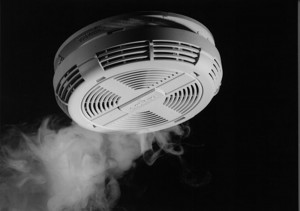
Will Your Current Smoke Detector Save You In A Fire?

smoke-detector

The recent 60 Minutes story on smoke detectors has prompted a number of clients to ask us about the safety and effectiveness of their existing smoke alarms.

The story featured fire safety expert David Isaac, who expressed concern that some smoke detectors were too slow to react and would not allow the occupants of a home enough time to safely escape in the event of a fire.

There are two types of smoke detector available, Ionisation and Photoelectric, and they both detect fires differently.

The ionisation type is better at detecting fast developing fires with lots of flames, while the photoelectric type is better at detecting the slow, smouldering type of fire which can produce a lot of smoke before there are any flames.

Ionisation types are also more susceptible to false alarms from burnt toast and even bathroom steam.  Unfortunately this often leads to people disabling them, with sometimes tragic consequences.

While both types of smoke alarm will detect a fire, David Isaac believes the photoelectric type provides better protection.

By the time a smouldering fire progresses to the flaming stage it may have produced quite a lot of smoke, already incapacitating the sleeping occupants of a home, or making it very difficult for them to escape the burning building.

Both types of smoke alarm comply with Australian Standard AS3876, so why do over 90% of Australian homes have an ionisation type detector?

Until quite recently, photoelectric smoke alarms were three or four times the price of an ionisation type detector.  When faced with spending either $29 or $89 per detector most consumers have selected the cheaper option.

So, why don’t they make a smoke alarm that combines both methods of detection?

Actually there are dual mode smoke alarms available, however at the moment they are all 9 volt battery models.  We have not yet seen a 240 volt version of the dual sensor smoke alarm.

It is important to note, that these 9v battery operated dual mode alarms do not comply with current Tasmanian regulations for smoke detectors in rental properties and new homes.  In these properties your smoke detector, (ionisation or photoelectric) must be 240 volt hard wired or have a 10 year lithium battery.

If you have a smoke detector in your home it’s most likely the ionisation type, so what should you do?

No matter what type of smoke alarm you have it only provides protection if it’s in working order so you should change the batteries and test your alarms regularly, as per the manufacturer’s instructions.

Photoelectric smoke alarms are now much cheaper than they used to be so if you are considering replacing your old ionisation models please give us a call to obtain an obligation free quotation.

Phone Mance Electrical on 6331 4711.  

Frequently asked questions

Can lightning damage my home even without a direct strike?

Yes. Your home can still be damaged even if lightning does not strike the building directly. A nearby strike can send energy through electrical wiring, plumbing, power lines, or the ground, which may damage your switchboard, appliances, and internal electrical systems.

How does lightning enter a house?

Lightning can enter a house through several pathways, including electrical wiring, switchboards, plumbing, phone and data lines, antenna cables, and ground current. This is why homes can be affected by nearby strikes as well as direct ones.

What happens when lightning strikes near your home?

When lightning strikes nearby, it can create dangerous power surges, trip circuits, damage appliances, affect your switchboard, and in some cases start electrical fires. Some damage is immediate, while other faults may remain hidden until later.

Can lightning really damage my computer, TV or appliances even if it doesn’t strike my house directly?

Yes, an indirect lightning strike, for example to nearby power lines, ground, or trees, can send powerful surges through wiring, data lines, or plumbing into your home and damage electronics. If a storm is approaching or thunder is heard, unplug non-essential devices immediately.

Is it safe to shower, wash dishes or use water during a thunderstorm?

No, plumbing and water conduct electricity, so using water during a storm is risky. Avoid showers, baths, sinks, washing machines, or other plumbing-connected appliances whenever there is thunder or lightning.

Are surge protectors enough to protect my home and devices from lightning?

Not necessarily. Surge protectors help with ordinary surges, but they are typically insufficient against the massive energy of a nearby or direct lightning strike. For better protection, consider grounding, whole-home surge arresters, or a full lightning protection system.

If lightning strikes nearby, but not my house, could my home still be at risk?

Yes. Ground current, soil conduction, or nearby strikes can transmit dangerous current through plumbing, wiring, or foundations, even when your home was not directly hit. Treat any thunderstorm seriously, unplug devices and avoid water or conductive contact until the storm passes.

Is it safe to use cordless or mobile phones during a thunderstorm?

Yes, as long as the phone is not plugged in or wired to the home’s electrical or phone system. Avoid using corded landline phones during storms.

How far away can lightning still be dangerous?

Lightning can still be dangerous even when the storm does not seem directly overhead. If you can hear thunder, you are close enough to be at risk and should move to proper shelter immediately.

Can lightning cause a house fire?

Yes. Lightning can overload wiring, damage switchboards, and ignite building materials, especially in homes with older electrical systems or inadequate surge protection.

Do I need lightning protection for my home?

Not every home needs a full lightning rod system, but many homes benefit from proper grounding, whole-home surge protection, and an up-to-date switchboard. A licensed electrician can assess your level of risk and recommend the most suitable protection.

Call Now Button